Spanish Shadowing: How to Practise It with YouTube Videos
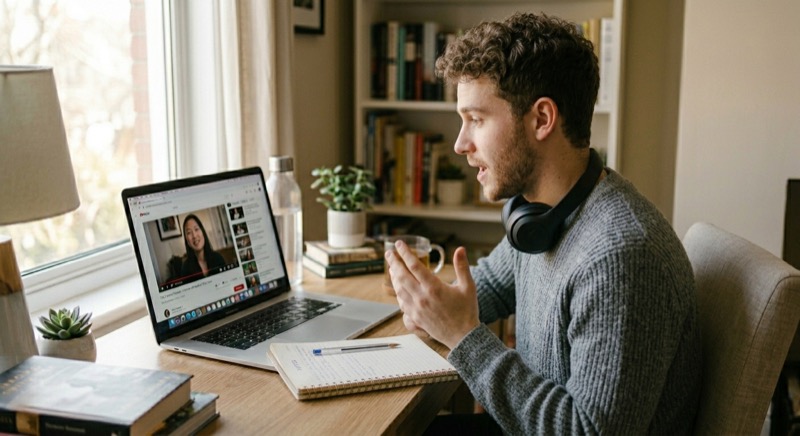
Shadowing means repeating out loud what you hear, at the same time as the speaker, copying their rhythm and intonation. Not after they finish — at the same time, a fraction of a second behind, like a shadow.
It sounds odd and it feels ridiculous the first few times. It is also one of the few exercises that trains listening and pronunciation in the same minute.
🧠 Why it works
When you repeat at the same time as the speaker, you cannot stop to translate. There is no gap in which to think "what does that word mean" — you have to keep up. That forces your brain to process Spanish as sound, directly, which is exactly the skill that fails when someone talks to you at normal speed.
It also does something for your mouth. Spanish has vowels and rhythms that English does not, and reading them on paper never teaches you to produce them. Copying a native speaker does.
📝 How to do it, step by step
- Pick a short clip. Thirty seconds to two minutes. Long enough to have rhythm, short enough to repeat many times.
- Listen once, no subtitles. Just to know what it is about.
- Listen with Spanish subtitles. Check what you actually missed.
- Read out loud with the subtitles, video paused. Get your mouth around the words with no time pressure.
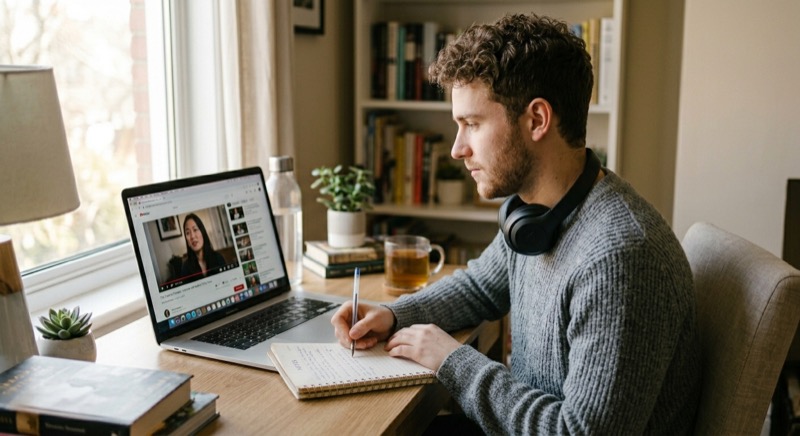
- Now shadow. Play it and speak along, a beat behind, subtitles on if you need them.
- Shadow with subtitles off. This is the real exercise.
- Repeat the same clip for several days. Five minutes a day on the same thirty seconds does more than five new clips.
🎯 What material to use at each level
| Level | Material | Why |
|---|---|---|
| A1-A2 | Learner channels, slow and clearly articulated | You need to be able to keep up at all |
| B1 | Vlogs, cooking, travel — one person talking to camera | Natural speed, one voice, visible mouth |
| B2 | Interviews, podcasts on video | Two speakers, interruptions, real rhythm |
| C1 | Comedy, fast debate, regional accents | The hardest thing there is |
The one requirement at any level: you must be able to understand the clip before you shadow it. Shadowing sounds you do not understand is parroting, and it teaches you very little.
Good sources are in the best YouTube channels to learn Spanish.
⚠️ The mistakes that make it useless
- Clips that are too long. You lose concentration by the end and end up mumbling.
- Material you do not understand. See above.
- Doing it silently. It has to be out loud. Half the benefit is in your mouth, not your ear.
- Going too slowly. If you leave a long gap after the speaker, you are repeating, not shadowing, and you have given yourself time to translate.
- New material every day. Repetition on the same clip is where the gains are.
🎧 Shadowing and gap filling together
Shadowing trains production: your mouth, your rhythm, your speed. What it does not test is whether you actually caught every word — it is easy to shadow a phrase convincingly while skating over one word you never quite heard.
That is the complementary exercise. Gappier takes the real subtitles of a YouTube video, hides some of the words, and pauses until you type what you heard. You cannot skate over anything. Used together, one trains your mouth and the other catches what your ear is missing.
❓ Frequently asked questions
How long should a shadowing session be?
Five to ten minutes. It is tiring in a way passive watching is not, and quality drops fast after that.
Can I shadow with podcasts instead of video?
Yes, though video is better at the start because seeing the speaker's mouth helps. Podcasts are good once you are at B1 or above.
Does shadowing work for a Mexican or Castilian accent specifically?
That is one of its strengths: you copy whichever accent you choose. If you want Mexican Spanish, shadow Mexican speakers. See Mexican, Castilian or Latin American Spanish.
What does "shadowing" mean in Spanish?
There is no standard translation — Spanish speakers use the English word, or say la técnica del shadowing. You will also see repetición simultánea.
Is it better than just talking to someone?
Different things. Conversation trains you to produce your own sentences under pressure. Shadowing trains the raw mechanics of speed and pronunciation. Shadowing is something you can do alone, today, with no one else involved.
✅ In short
- Repeat out loud at the same time as the speaker, not after.
- Short clips, understood first, repeated over several days.
- Out loud always, even if you feel silly.
- Pair it with gap filling so nothing slips past your ear.