How to Improve Your Spanish Listening (When You Read Fine but Understand Nothing)
You can read a Spanish article without much trouble. You know the grammar. And then someone speaks to you and it is a wall of noise with maybe three recognisable words in it.
This is the most common complaint in Spanish learning, and it is not a sign that you are bad at languages. It is a sign that reading and listening are different skills, and you have only trained one.
🧠 Why your listening lags behind your reading
When you read, you control the speed. You stop, go back, look at a word for two seconds. When you listen, the speaker sets the pace and does not wait for you.
On top of that, spoken Spanish does not sound like written Spanish. Native speakers run words together, drop consonants, swallow endings. ¿Para dónde vas? becomes something closer to ¿Pa'ónde vas?. You are not failing to understand vocabulary you know — you are failing to recognise it in the shape it actually arrives in.
The fix is exposure to that shape, in quantity, at a difficulty you can survive.
📊 The difficulty rule
This is the part most people get wrong. You need material where you understand most of it but not all of it.
- Understand 95%+ → comfortable, but you are not learning much.
- Understand 70-90% → this is where listening improves.
- Understand under 50% → your brain stops tracking and you get nothing, no matter how long you persist.
If a video leaves you under half, it is not a discipline problem. Change the video. Nobody improved their listening by staring at incomprehensible audio and feeling bad.
🎧 Four exercises that beat passive watching
Watching with subtitles on, start to finish, once, is the weakest thing you can do. These are better, roughly in order of effort:
1. Listen first, read after. Play a sentence with subtitles off. Decide what you heard. Then turn them on and check. Slow, and by far the highest value per minute.
2. Watch it twice. First pass with Spanish subtitles for the plot, second pass without, for the ear. Almost nobody does this and it is free.
3. Shadowing. Repeat out loud at the same time as the speaker, copying rhythm and intonation. Trains listening and pronunciation together. Details in Spanish shadowing.
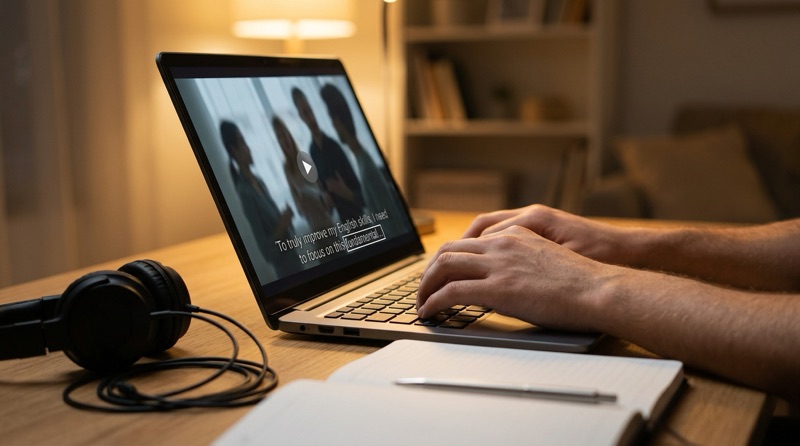
4. Gap filling. Take real subtitles, hide some words, and make yourself write what you hear. It forces the ear to do the work in a way nothing passive does. This is what Gappier does with any YouTube video: it pauses on the hidden word until you type it.
🗣️ Get used to more than one accent
A Mexican, an Argentinian and a Spaniard do not sound alike. If all your listening comes from one country, you will understand that country and freeze at the others.
Once you are past the beginner stage, deliberately mix: a week of Mexican content, a week of Spanish from Spain, a week of Colombian. See Mexican, Castilian or Latin American Spanish.
📅 A twenty-minute routine
- Ten minutes, new material. A video at your level, Spanish subtitles on.
- Five minutes, the hard part again. The section you missed, listen first and read after.
- Five minutes, active. Shadow a passage out loud, or do a round of gap filling.
Daily beats intensive. Listening is built by frequent exposure, not by marathons.
❓ Frequently asked questions
How long until my listening improves?
With twenty minutes a day at the right difficulty, most people notice a change in six to eight weeks. The jump tends to be sudden rather than gradual: one day a video that used to be hard is simply easy.
Do podcasts work for listening?
Yes, and they are harder than video because you lose the visual support. Good for B1 upwards. See learn Spanish with podcasts.
Should I listen while doing something else?
Background listening does almost nothing at low levels — you need attention for your brain to map sound to meaning. It becomes useful at B2+, as extra exposure on top of focused practice.
Is it normal to understand a teacher but not a native speaker?
Completely. Teachers speak slowly and articulate for you. That is why the step from learner channels to real content matters so much: it is a different skill, and you have to make it on purpose.
What if I understand the words but not fast enough?
That is a processing speed problem, and repetition fixes it. Rewatching the same material is more effective here than new material, because you stop decoding vocabulary and start just listening.
✅ In short
- Reading and listening are separate skills; train listening directly.
- Pick material where you understand 70-90%.
- Passive watching is the weakest option: listen first, rewatch, shadow, fill gaps.
- Mix accents once you are past beginner.
- Twenty minutes a day, every day.