Learn Spanish with Games: What Works and What Just Feels Productive
Games are excellent at one thing language learning badly needs: getting you to come back tomorrow. They are considerably worse at a second thing it needs, which is producing real language under real conditions.
Both halves of that are worth taking seriously.
🎯 What games are genuinely good at
- Repetition without tedium. You will happily do forty rounds of something you would never do as forty exercises.
- Low-stakes mistakes. Getting it wrong costs nothing, so you try things you would not risk in conversation.
- Habit. A streak is a crude motivator and it works.
⚠️ What they are not good at
- Real listening. Game audio is clear, slow and waits for you.
- Producing your own sentences. Selecting the right answer is recognition, not recall.
- Feeling like progress without being progress. This is the real risk: twenty minutes of gamified matching can feel more productive than twenty minutes of difficult video, while teaching considerably less.
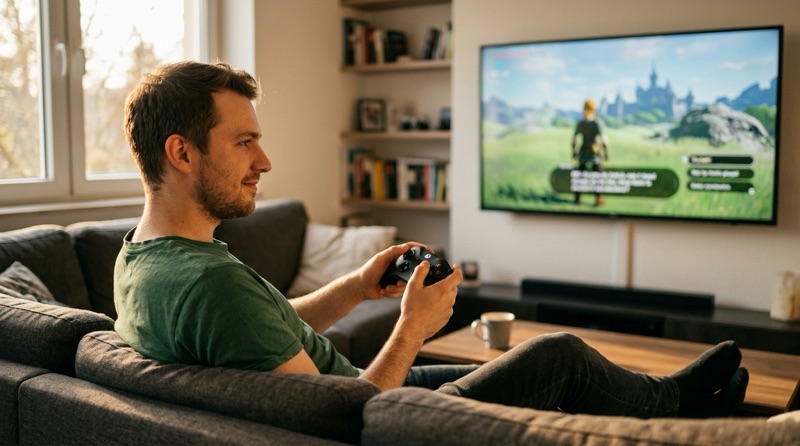
🎮 Playing actual video games in Spanish
The most effective "game" approach, and the least gamified. Switch a game you already play to Spanish — menus, subtitles, voice acting.
Why it works:
- You already know the context, so unfamiliar words are guessable.
- Narrative games give you hours of dialogue with real emotion behind it.
- You are playing anyway. The Spanish is free.
What to choose: story-driven games with plenty of dialogue. Avoid anything where you need to read fast under time pressure — you will switch back to English within the hour.
🧩 Word games and puzzles
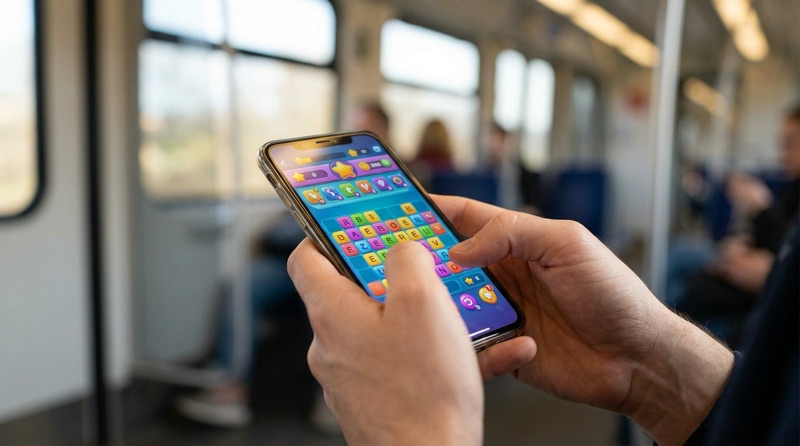
- Crosswords and word searches in Spanish — good for spelling and vocabulary recall, useless for listening.
- Wordle in Spanish and similar — five minutes a day, decent for common letter patterns.
- Card and board games with Spanish speakers — unglamorous and genuinely effective, because you have to speak to play.
👧 Games for children
Games are a much better fit for children than for adults, because at that age play is the learning method rather than a substitute for it. See learn Spanish for kids.
🎧 Where games fall short, and what fills the gap
The gap is always the same: games train recognition, and conversations demand recall from sound.
The complement is active listening practice on real speech. Gappier is close to a game in shape — it hides words from a YouTube video's real subtitles and pauses until you type what you heard, so you get the round-by-round feedback loop — but the material is native speakers at natural speed rather than recorded lesson audio.
❓ Frequently asked questions
Can you learn Spanish by playing games?
Playing a real video game in Spanish, yes, substantially. Playing language games, partially — they build vocabulary and habit but not comprehension of real speech.
Is Duolingo a game?
Effectively, and that is its strength and its limit. See the best free apps to learn Spanish.
What games are good for learning Spanish?
Story-driven video games you already enjoy, switched to Spanish. For vocabulary, word games. For speaking, board and card games with other people.
Should I switch my games to Spanish as a beginner?
Below A2 it is frustrating — you will not have enough vocabulary to follow, and games rarely offer a slow mode. From B1 it works well.
Are free Spanish learning games worth it?
As a habit anchor, yes. Just do not count the time as your listening practice, because it is not.
✅ In short
- Games are good at habit and repetition, poor at real listening and speech.
- The best version is playing a game you already enjoy, in Spanish.
- Watch for activity that feels productive while teaching little.
- Pair them with practice on real native speech.