Learn Spanish for Kids: How to Use Video Without It Becoming Screen Time
Children do learn languages from video, but not the way the marketing suggests. Putting a cartoon on in Spanish and walking away produces very little. What produces a lot is video plus an adult who engages with it, even an adult whose Spanish is worse than the child's will soon be.
This is a guide for parents, not for children.
🧠 How children actually pick it up
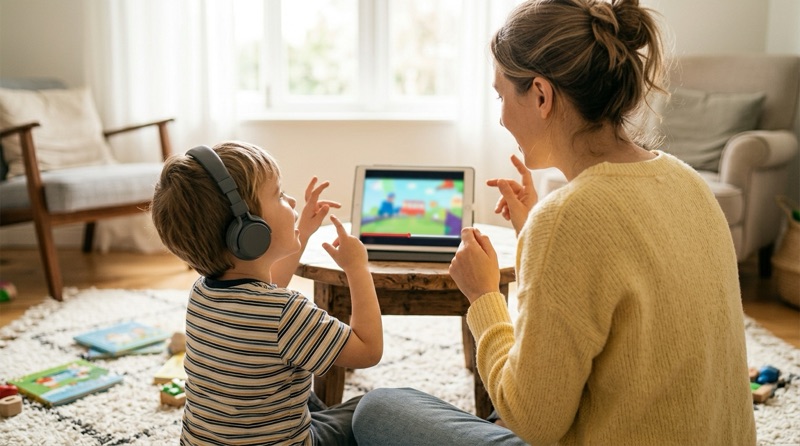
Young children learn language from interaction, not from exposure alone. The research on this is consistent and slightly inconvenient: a toddler watching a screen alone learns dramatically less than the same toddler watching with someone who points, names things and responds.
What that means in practice: the video is the material, you are the method. You do not need good Spanish. You need to pause, point and ask "¿qué es eso?".
👶 By age
2-4 years. Songs and very simple cartoons. Repetition is the whole point — the same five songs for a month is correct, not lazy. Look for videos with strong visuals where the word and the thing are on screen together.
5-8 years. Short cartoons with a story. Children can follow a plot now, which carries vocabulary along with it. Dubbed versions of shows they already love work well: they know what happens, so the Spanish is the only new thing.
9-12 years. Real content — vlogs by kids, science channels for children, gaming videos in Spanish. At this age motivation carries more weight than method: something they would choose in English, chosen in Spanish.
Teenagers. Treat them as adult learners with better instincts about what is boring. Learn Spanish on YouTube applies.
📺 What to look for in a channel
- Slow, clear speech with plenty of repetition.
- Meaning visible on screen — the object, the action, the gesture.
- Spanish only. Channels that translate everything into English teach children to wait for the translation.
- Songs, which embed rhythm and pronunciation better than speech does.
Specific channels are in YouTube channels to learn Spanish for kids.
⏱️ How much screen time
Fifteen to twenty minutes a day is enough at these ages, and more is not proportionally better. What multiplies the effect is what happens around it:
- Watch with them at least some of the time.
- Reuse the words off-screen. If the video was about fruit, name the fruit at breakfast tomorrow.
- Same video, several times. Children like repetition and it is exactly what language learning needs.
🎮 Beyond video
- Songs in the car. The lowest-effort exposure there is, and rhythm does a lot of the work.
- Games. See learn Spanish with games.
- Books they already know, in Spanish. Known plot, new words.
👨👩👧 If you are learning alongside them
Common, and it works better than either of you learning alone. Children are not embarrassed to repeat things out loud, and you get a partner who will correct your pronunciation without mercy.
Do the same videos. Then do your own practice separately, at your level — Gappier works on any YouTube video, including the cartoons, by hiding words from the real subtitles until you type what you heard.
❓ Frequently asked questions
Can a child learn Spanish just from YouTube?
Not from video alone. From video plus an adult who interacts with it, yes, surprisingly well.
At what age should we start?
Any. Earlier gives a better accent; later gives faster vocabulary. There is no age at which it becomes too late.
Do cartoons in Spanish count as screen time?
Yes, and it is worth being honest about that rather than treating language content as exempt. Keep it within whatever limits you already use.
Should I use subtitles for children?
Not for pre-readers. For children who read comfortably, Spanish subtitles help — never English ones. See Spanish subtitles or English subtitles.
My child watches but never speaks Spanish. Is it working?
Probably. Comprehension comes a long way before production, and a silent period is normal. Ask questions that need a one-word answer rather than waiting for sentences.
✅ In short
- Video is the material; an involved adult is the method.
- 15-20 minutes daily, the same videos repeatedly.
- Spanish-only channels with meaning visible on screen.
- Reuse the words off-screen, or they stay on the screen.