Learn Spanish with Music and Songs
Music is the resource everyone already has. You do not need to schedule it, you do not need discipline, and you will happily hear the same song forty times — which is exactly the repetition language learning needs and nobody willingly does with a textbook.
The catch: listening to Spanish music teaches you almost nothing on its own. Here is how to make it count.
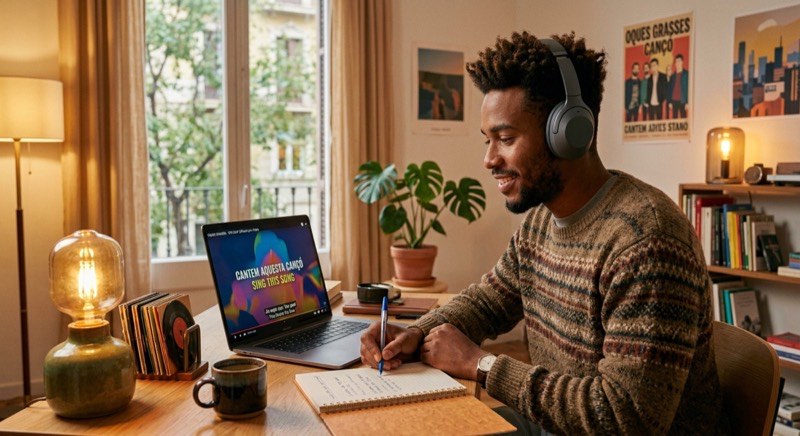
🧠 Why songs stick when sentences do not
Melody and rhythm are memory aids. Words attached to a tune survive in your head far longer than words on a list, which is why you still know the lyrics to songs you have not heard in twenty years.
Songs also give you natural pronunciation and rhythm for free. Spanish has a syllable-timed rhythm quite unlike English stress-timing, and singing along trains that in a way reading never will.
What songs are bad at: normal sentence structure. Lyrics invert word order, drop pronouns and use imagery no one says out loud. Music is a supplement, not a syllabus.
🎯 A method that works
- Listen once, no lyrics. See what you catch.
- Read the lyrics in Spanish while it plays. Not the translation yet.
- Now check the translation for the parts you could not work out.
- Sing along. Out loud. This is where the pronunciation work happens.
- Listen again over the next few days without lyrics. You will be surprised what now arrives clearly.
Steps 2 and 3 in that order matter. Reading the translation first means you never make the effort, and the song becomes background noise you happen to know the meaning of.
🎵 What to listen to, by level
| Level | What works | Why |
|---|---|---|
| A1-A2 | Children's songs, slow ballads, Spanish covers of songs you know | Clear articulation, simple vocabulary, heavy repetition |
| B1 | Pop and singer-songwriters — Jesse & Joy, Manu Chao, Shakira's Spanish catalogue | Normal vocabulary, comprehensible at speed |
| B2 | Reggaeton and Latin urban — Bad Bunny, Rosalía | Fast, slang-heavy, regionally specific |
| C1 | Rap, wordplay, regional folk | Dense and culturally loaded |
Bad Bunny is not beginner material, despite being where most people start. Puerto Rican Spanish drops consonants heavily, the slang is specific and the delivery is fast. Excellent at B2, frustrating at A2.
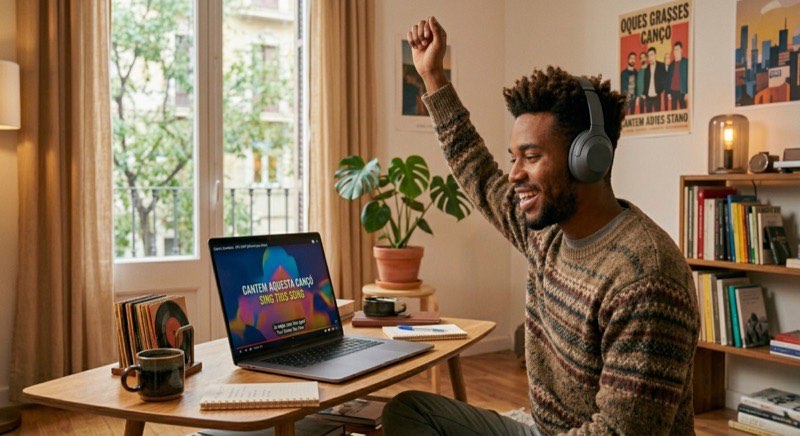
🎤 Karaoke versions, seriously
Search a song plus karaoke or letra on YouTube and you get the lyrics on screen, timed to the music. That is dual-coding — hearing and reading the same language simultaneously — which is exactly what makes Spanish subtitles work for video.
Singing along also forces you to keep up with native speed, which is the same mechanism as shadowing, except enjoyable.
🎧 Turning a song into practice
Music videos and lyric videos are on YouTube, which means they work with the same active exercises as anything else. Gappier hides words from a video's real subtitles and pauses until you type what you heard — on a song you have listened to five times, it is a fast way to find out which words you have been mishearing all along.
❓ Frequently asked questions
Can you learn Spanish just from music?
No. You will pick up vocabulary, pronunciation and rhythm, but not sentence structure or the ability to follow normal speech. Use it alongside video.
Is listening to Spanish music while working useful?
Barely, at low levels. Background exposure without attention does very little until you are at B2 or so. The five minutes actively working through lyrics beats two hours of background.
What are good songs to learn Spanish for beginners?
Slow ballads and children's songs, plus Spanish versions of songs you already know in English — known meaning, new words.
Does reggaeton teach bad Spanish?
It teaches informal, regional Spanish, which is real Spanish. Just do not expect the register to be appropriate everywhere, and do not start there.
Where do I find the lyrics?
Search the title plus letra. Lyric and karaoke videos on YouTube are usually better than lyrics sites because they are timed to the audio.
✅ In short
- Songs give you repetition you would never tolerate from a textbook.
- Lyrics in Spanish first, translation second.
- Sing out loud — that is where the pronunciation work happens.
- Bad Bunny at B2, not at A2.