Learn Spanish with TV Shows and Telenovelas
Watching series is the most enjoyable way to learn Spanish and the easiest to do badly. Three seasons of a Spanish-language show with English subtitles teaches you almost nothing, and plenty of people have the receipts.
Done properly, though, series give you something no lesson does: hours of real dialogue you actually want to sit through.

📺 Series made for learners
Start here if you are below B1. These were produced to teach, with controlled vocabulary and a real plot:
- Extra en Español — 13 episodes, sitcom structure close to Friends, made for learners. Roughly A2. The easiest entry point there is.
- Destinos — 52 episodes from 1992, a telenovela built as a Spanish course. English narration fades out as it goes. A2-B1, and still excellent despite the clothes.
Both are on YouTube in full and free.
🎭 Why telenovelas beat prestige drama
Counter-intuitive, but it holds up. A telenovela is better learning material than an acclaimed Spanish-language series, for three reasons:
- The dialogue is explicit. Characters say what they feel, out loud, repeatedly. Prestige drama does the opposite.
- The plot is redundant. Events get recapped constantly, so missing a line costs you nothing.
- The vocabulary is domestic. Family, love, money, betrayal — the words you will actually use.
Meanwhile a show with mumbled dialogue, overlapping voices and heavy slang is the hardest listening there is, however good it is as television.
🌎 Where to start by level
| Level | What to watch |
|---|---|
| A2 | Extra en Español, children's cartoons in Spanish |
| B1 | Destinos, classic telenovelas, dubbed shows you already know |
| B2 | La Casa de Papel, Velvet, Valeria, Gran Hotel |
| C1 | Comedy, regional slang, documentaries, anything native |
A trick worth knowing: watch a series you already know well, dubbed into Spanish. You know the plot, so you can spend your attention on the language. Not authentic Spanish, but very effective at B1.
💬 The subtitle rule
This is where most people lose the benefit.
Spanish subtitles, not English. With English on screen your eyes read English and your ears switch off. With Spanish subtitles you read and hear the same language, and you start recognising by ear what you already knew on paper.
One warning specific to streaming: Spanish subtitles often do not match the Spanish audio word for word, because subtitles and dubbing are produced separately. La Casa de Papel is the classic case — people search for subtitles that line up with season 1 precisely because the ones they have do not.
Full breakdown in Spanish subtitles or English subtitles.
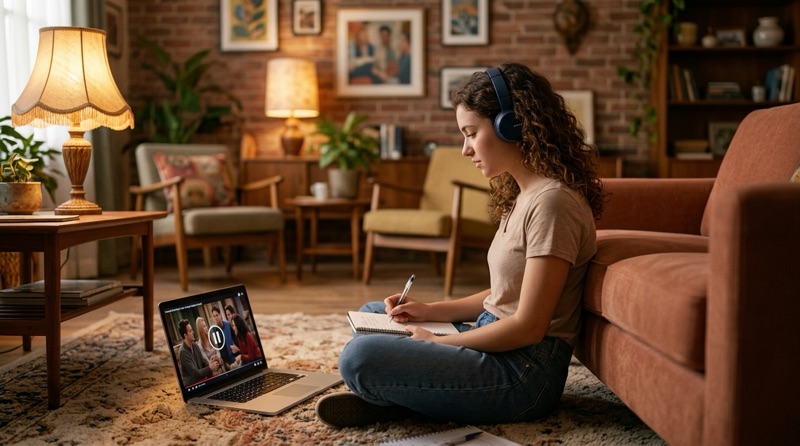
🎧 How to watch an episode so it teaches you something
Forty minutes of passive watching is worth less than fifteen minutes of this:
- Watch the episode normally, Spanish subtitles, for the plot.
- Pick one scene of two or three minutes that you liked.
- Rewatch it with no subtitles. Notice what you miss.
- Rewatch with subtitles and see what it was.
- Shadow a few lines out loud — see Spanish shadowing.
If you want that made mechanical, Gappier does it on YouTube clips: it hides words from the real subtitles and pauses until you type what you heard.
⚠️ Where to watch, and the catch
Streaming platforms are inconsistent about Spanish subtitles for Spanish audio — some offer English only, some have subtitles that drift out of sync with the dub. YouTube is more reliable for learning, because captions and audio come from the same source, and there is a surprising amount of full-length Spanish-language film and series on it legally.
❓ Frequently asked questions
Can you learn Spanish just by watching series?
You can build a lot of comprehension. What series alone will not give you is production — speaking and writing. Pair them with something active.
Is La Casa de Papel good for learning?
At B2 and up, yes. Below that, the pace and the overlapping dialogue make it frustrating. Start with Extra en Español or Destinos.
Should I watch with English or Spanish subtitles?
Spanish. Always, if your level allows it at all.
Do dubbed shows count?
For listening practice, yes, and they are easier because dubbed audio is recorded clean in a studio. For slang and natural rhythm, original Spanish-language content is better.
What about films rather than series?
Same rules, less repetition to help you. See learn Spanish with movies.
✅ In short
- Below B1, use series made for learners: Extra en Español, Destinos.
- Telenovelas beat prestige drama as learning material.
- Spanish subtitles, and expect them not to match dubbed audio exactly.
- One scene worked properly beats a whole episode watched passively.